Saturday, May 8, 2010

Beauty like none other


By Jeremy Alistair McCamish

Today we left or hotel in Dublin to go to Galway where we will be staying a single night in a hostel. On our way to Galway we stopped at two very amazing places. First we stopped at Trim Castle where the movie Braveheart had been filmed for a few battles in the movie. It was awesome to see but it was said to find out that the Castle had specifically been rebuilt from the way that it was to a more restored look just for the filming of Braveheart. That didn't stop us from having fun though. Justin and I free climbed over just about every thing we could even though we weren't suppose to.
Yeah Justin and I know how to have fun in Ireland
Also I have never seen or felt such a beautiful breeze of wind. The way it had hit the grassy plains was amazing. It gave a sense of life to a place that had scene alot of death. After that we headed for Clonmacnoise. Clonmacnoise was a site full of religious history. It was run by a group of monastic monks who had been responsible for rebuilding it after each attack that had come. Clonmacnoise had been attacked over 50 times and the majority of the attacks was by the local Irish. Inside the site was Four Churches, Three High Crosses, thousands of buried dead, and over 600 gravemarkers.
The four churches were made up of the main Church, the two churches dedicated to specific saints, and the King's Church. On the North Entrance of the Main Church is an arch doorway known as the Whispering Arch. The monks would use this arch to confess their sins. One monk would be on one side and another monk on the opposite side listening to his confession through the arch. Spencer and I were chosen to test it and it definitely worked. You could hear the whispers as clearly as if they were whispering right in your ear.
Spencer you better not tell anyone what I told you
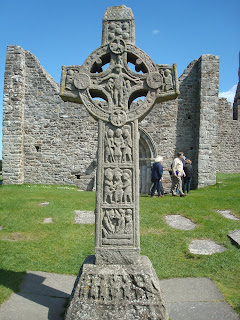
The three crosses are made up of the North and South Crosses and the Cross of Scriptures (they are sure that there would have been a fourth cross but it has yet to be found). The Cross of Scriptures has scenes from the bible depicted on it. Scenes such as the crucifixion and the rapture. To this day they are still working to restore the churches back to the way they should have looked and they have alot of the original articfacts in the museum, such as the three crosses. Another fun fact about Clonmacnoise is that Pope John II had given a speech their in the 1970's during his own personal pilgrimmage through Ireland. About 30,000 people showed up to see him even though he had never originally planned on going to Clonmacnoise. After leaving Clonmacnoise I saw many beautiful sights. Normally on trips I fall asleep in the bus or car but at this point I couldn't keep my eyes shut. The grassy hills were just so beautiful that I couldn't take my eyes off of them, even if they all looked the same. It almost looked fake it was so amazing. I wished to run all over those hill tops. Amy I wish I could take you around the country side and show you how amazing it is. Then I could see the two most beautiful things I've seen in this world all together. God has truly blessed me.
Tidbits and Whatnot from the Isle of Ireland.

Well, all you awesome people following us on this British Isles adventure-ness, it's Spencer. We got some free time at the student hostel here in Galway, so I thought I'd try my hand at blogging.

So, I know you've all heard and seen what we've been doing so far in Dublin, and our little excursions to Newgrange, Trim Castle, St. Patrick's Cathedral, Clonmacnoise, and the Hill of Tara. So, there isn't really anything else new here. But, I'm posting something, and there are pictures, so I thing checking it out would be pretty awesome! You just might learn something...
...or not.


Anyway, so, I don't think I've walked so much in one sitting. Seriously, our only form of transportation through the city of Dublin was our two God-legs and the feet that we got attached. And shoes, those were helpful. But the sights! Holy smokes, nearly everything that is there in Dublin has a history, or a story, or a connection with the Guinness family. I mean, our sense of history in the States is nothing compared to the heritage here on the Isles. Even the most paltry of historical importance is older than our entire country. It never ceases to amaze me.

A little note on the Guinness family that we learned from Josephine: the Guinness family invested a huge amount of money in the city of Dublin, building shelters for the homeless, investing in housing and politics, and bringing revenue and providing jobs. And...they actually paid for the refurbishing and restoration of St. Patrick's Cathedral. Yeah. How's that for a church? That would explain why they sell shot glasses at the shop...
So, the whiskey distillers caught onto the idea of giving back to their churches' heritage, so they in turn funded for the restoration of Christ's Church. So, as the saying goes, "St. Patrick's was built with pints, and Christ's Church was built with glasses."

And the pubs in Dublin! Pubs, pubs, pubs! You couldn't walk down a street without finding a pub somewhere, usually on both sides of the street, and within three or four buildings of each other, traditional Irish music and drinking songs blasting from their open doors. Guinness and Bushmills is to Ireland like Tecate and XX is to Mexico, or Bud Light and water is to America (so classy...). By far, the best place to go was the Temple Bar district in the heart of downtown. Some of the best pubs, some of best interest shops, and most of the more "colorful" population. By far, the best place that we went was the Temple Bar.

Yeah, it was so good, it didn't need to have a name like "McDonagh's" or "Finnigan's"

Jeremy, Justin, and I stopped in for dinner, and we had some pretty awesome sandwiches. Oh, and the pub was pretty awesome, too. I have to say, I don't think I've seen that much alcohol in one place. American bars have nothing on Ireland. Seriously, it was so full that it needed two bars. And the fill capacity is 600 people. That's not sitting room, but how many people can be crammed in standing up with just enough room to pass drinks around. And the live music was quite good. All in all, the best pub that we found while we were in Dublin. Not that we were pub hopping or anything...

And Kaitlan, Jeremy, Justin and I discovered the best place for fish 'n chips. It was a little hole-in-the-wall called the Red Herring. For 10 euro, you can get a side of fresh-fried fish and award-winning chips with a side of mushy peas, served up by an Irish hipster singing Lady Gaga. Seriously, the fish was, like, half of a cod! It was huge! And, mushy peas...don't knock them until you try them. They're a dip, not an entity all to themselves. They were good. Don't judge.

And in Galway, McDonaugh's fish 'n chips, best fish 'n chips so far. And me and Jeremy got in touch with our Scottish roots. We got a some haggis, and it was surprisingly good.

There's already so much information on what we've done, so I'll just leave that pretty much as it is. I just wanted to throw in my 2 cent-euros worth. You know, for posterity's sake.
But, I can see why so many people love this country. And I can feel why the Irish are so fond of their heritage. The land is so beautiful and so rich with history and heritage, and the culture is vibrant and comfortable, if a bit rambunctious at times.
I can't help but get in touch with my Irish heritage, you know what I mean? Seeing the country for the first time is simply awe-inspiring. It makes me proud to be Irish.


One more thing before I jump off the blog: at the old monastic site at Clonmacnoise, there is a small path of inlaid stones that leads from the crossroads near the River Shannon in a straight line directly to the church housing the grave of Saint Ciarnan. Christians on pilgrimage would walk down this path to kneel at the foot of Ciarnan's grave and pay their respects, and offer up their prayers at this holy site. Walking down the path through the hundreds of gravestones, it was almost surreal. My feet walked on the same path that have been used for over a thousand years. It was a beautiful and reverent experience.


So, there's my little contribution to this little excursion. So, family and friends, we're safe (well, as safe as we can be...we are college students, so what other sorts of shenanigans could be possibly get into?) and having an awesome time.
And, Alicia, if you're reading this, just wanting to let you know that I miss you, and I love you. You'd love it here.

So, the adventure continues tomorrow! Hopefully I'll get another chance to toss in a few cents worth or so every once in awhile. And, with that, I bid you good night, because I'm going to bed, because I've been up since 4 am this morning (don't ask).

Love and stuff,
~Spencer Alexander

Trim and Clonmacnoise with a little Galway sprinkled on top.

Today was a traveling day, but we made two very important stops: Trim Castle and Clonmacnoise.

Trim Castle:


Best fun fact about Trim Castle: Before the creators of "Braveheart" rebuilt a lot of the structures, Trim Castle was a put put golf that the locals greatly enjoyed. They weren't too excited when it became an official national monument.

Trim castle was built over a thirty-year period by Hugh de Lacy starting in 1176. The first keep that was constructed was wood. Additions were made in the 1200's and became the fortified stone structure that we see today.


Trim castle is best known because of its debut in the movie, "Braveheart." Which, oddly enough, was about Scotland's fight for freedom and not Ireland's. However, we all seemed to be fighting those damn English.

The movie brought about renovations to Trim castle making it one of the most complete Anglo-Norman castles in Ireland.

We had a wonderful time walking around the Trim castle grounds. It continued to change over thirty years because attack tactics changed. Trim castle was one of the hardest castles to attack.

Clonmacnoise:

St. Ciarnan began the monastic site in the mid-6th century. He died at the age of 33, but had managed to begin one of the most influential religious sites of the area.


Three of the most beautiful Irish High Crosses are on this site. The Cross of Scriptures depicts the Gospel of Christ.


This is the South Cross and is the second oldest cross on the site.

The North Cross is the oldest cross on the site having been built in the year 800. It has more abstract Celtic designs. Sadly, it's missing the top portion of the cross.

Located on the River of Shannon, Ireland's longest river and major waterway, Clonmacnoise was a city of about 3,000 people. It would have been a bit like a university town. The monastery was where people could be educated and it was a major trading post.

Unfortunately, being in such a reachable area also meant that Clonmacnoise was easily susceptible to attack. Vikings and even the Irish and Celtics attacked and plundered the site. More than 40 attacks were recorded. We're lucky to have anything to see at this point.

It is believed that anyone buried in Clonmacnoise gets automatic admittance into heaven. Only one woman will be allowed to be buried on the site in modern days. Her husband was buried there in 1955, the year burials ended at Clonmacnoise. However, she has a right to be buried next to her husband an that will be honored.

The Whispering Arch is where sinners would come to confess their sins to priests. They would whisper their sins on one side of the arch and the priest would listen on the other side. The priest would give a penance without having to embarrass anyone. Jeremy and Spencer demonstrate.


Galway:

We only get to spend one night in Galway but we had delicious fish and chips and saw some fantastic street performers.

Friday, May 7, 2010

Dublin's quirks and priceless treasures.

Once again Josephine led us through history. This time it was through the city of Dublin. We've been in the city for two and half days now, but we didn't really know what was here.
Our first stop was the memorial for the men who lost their lives in the 1916 rise. The memorial was built in 1960 on the 50th anniversary of the event.

We continued through out the city and Josephine filled us in on the fight for Irish independence. It is surprisingly similar to that of the US fight for independence from the British. A declaration of independence was created as well as a constitution. Many lives were fought and civil war followed in the years after.

St. Patrick's Cathedral:

One word: astonishing. This amazingly detailed cathedral is still in use today and holds many artifacts of Ireland's history.

St. Patrick's story is amazing. He was essentially held captive and forced into slavery by Irish people. He escaped to Britain but returned to convert the pagans in Ireland to Christianity.

The cathedral was built adjacent to the well where it was suspected that St. Patrick baptized the converts of Dublin.Originally the cathedral was a Catholic church, but after Henry the VIII came to town, the church was forced to become Anglican.Despite this, the church contains all traces of its history.


There were extraordinary stained glass windows. The one pictured above is of King Cormac of Cashel.

The Door of Reconciliation is a famous story throughout Dublin. The Earl of Ormonde and the Earl Kildare were having a dispute over who knows what. They fought through the city and ended up chasing one another to the cathedral. They closed the cathedral door and cut a hole in it. Through the hole one of the Earls stuck their hand out and shook his opponent's hand. The term, "Chance your arm," is popular in Ireland and means "taking a risk."


The Guiness family (yes, of the beer) paid for the renovation of St. Patrick's cathedral and also for many welfare projects in the city. Including a hostel for the homeless.

Trinity College:


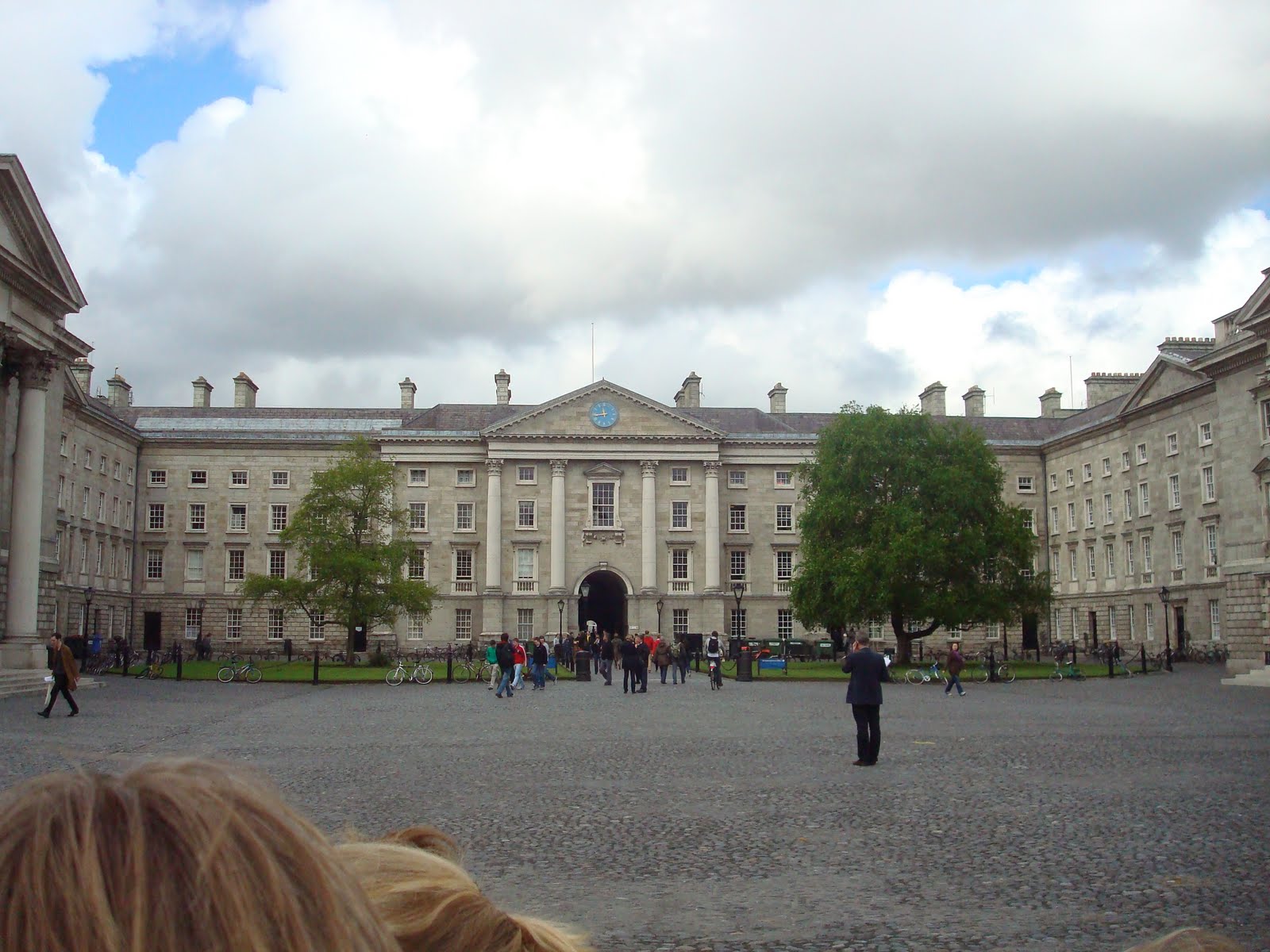
Trinity is one of the hardest colleges to be accepted into. Greats like William Butler Yeats attended and taught at this college.


Josephine was excited to show us the Oregon Maple trees on the campus.

Trinity College is also home to the Book of Kells and the largest library in Ireland. Unfortunately we weren't allowed to take pictures inside the exhibit for the Book of Kells or the library. However, it was absolutely stunning.

National Library, Museum, and Gallery:


Some of our group went to the Genealogy services at the National Library to look for information on their heritage. One of our group was very very lucky and will be surprising their family with some wonderful information.


Dublin:


Dublin is an extraordinary city. Here are some pictures of the city's quirks and historical features.

The colorful doors:

Some say that there are so many colorful doors in Dublin because when Queen Elizabeth demanded that all things be painted black in mourning of her late husband, Dubliners revolted and painted their doors different colors.

However, Josephine says the doors were painted bright colors so drunken husbands would be able to find their house at early hours in the morning.

Oscar Wilde:

This statue was made using different types of stones to make Oscar's clothes look as real as possible.

A lady dropped her scarf and didn't come back to pick it up, so a member of our group added it to the statue in the park. Just leaving our harmless mark on the city. =)

Molly Malone:

In Dublin's fair city where the girls are so pretty I first set my eyes on sweet Molly Malone As she wheeled her wheelbarrow,through streets broad and narrow Crying cockles and mussles alive,alive-oh.

She was a fishmonger and sure 'twas no wonder
For so were her father and mother before They both wheeled their barrows through streets broad and narrow Crying cockles and mussles alive,alive-oh.

She died of a fever and noone could save her
And that was the end of sweet Molly Molone But her ghost wheels her barrow through streets broad and narrow Crying cockles and mussles alive,alive-oh.

This is the popular poem/pub song about Molly Malone. It is sweet and endearing but Dubliners have other classy names for Molly: The Dish with the fish, or the Tart with the Kart.


That is all for Dublin. We head to Glaway with stops at Trim castle and Clonmacnoise Monestary site.

The Other Side of Dublin

For the past couple days we had only seen a little bit of Dublin, but today we got to see a whole new part of Dublin. We started near our hotel at Parnell Square in the Garden of Remembrance where we saw a beautiful fountain and a statue depicting the Children of Lear being chased by the swans. This story is told in old Irish Mythology of the Tuatha De Dannan. On our bus tour we saw many different statues and amazing sites. One amazing statue of Oscar Wilde using different types of stones to make him look as realistic as possible. We saw the Christ Church Cathedral and the St. Patrick's Cathedral, and we actually got to go into the St. Patrick's Cathedral and see the amazing sculptures and stained glass windows. We learned that the Guinness Family donated alot of money to the town and actually donated for the restoration of the St. Patrick's Cathedral as well as many other parts of Dublin. The Cathedral's were originally Catholic but at the time that Oliver Cromwell came and killed many of the Catholics they changed to Anglican. The St. Patrick's Cathedral was beautiful but by far my favorite site to see was the Book of Kells at Trinity College. We got to see the beautiful artistry of what was in the Book of Kells and the symbolism of all that was in it. Trinity College itself was amazing but the Book of Kells was beautiful and amazing and it definitely made me proud to have roots in Ireland. To all my Family and Friends and my love Amy, I miss you and definitely wish you were here with me throughout this experience.
Love, Jeremy Alistair McCamish


The Stained Glass Window at the front of the St. Patrick's Cathedral
In the middle is St. Patrick

Inside the campus of Trinity College

Thursday, May 6, 2010

Ancient Egyptians have nothing on the Neolithic Irish.

Today we went from the County Meath to the County Louth to experience some of the oldest and most important historical sites in Ireland. We hopped on to our ginormous coach and headed out with our wonderful tour guide, Josephine.


The Hill Of Tara:

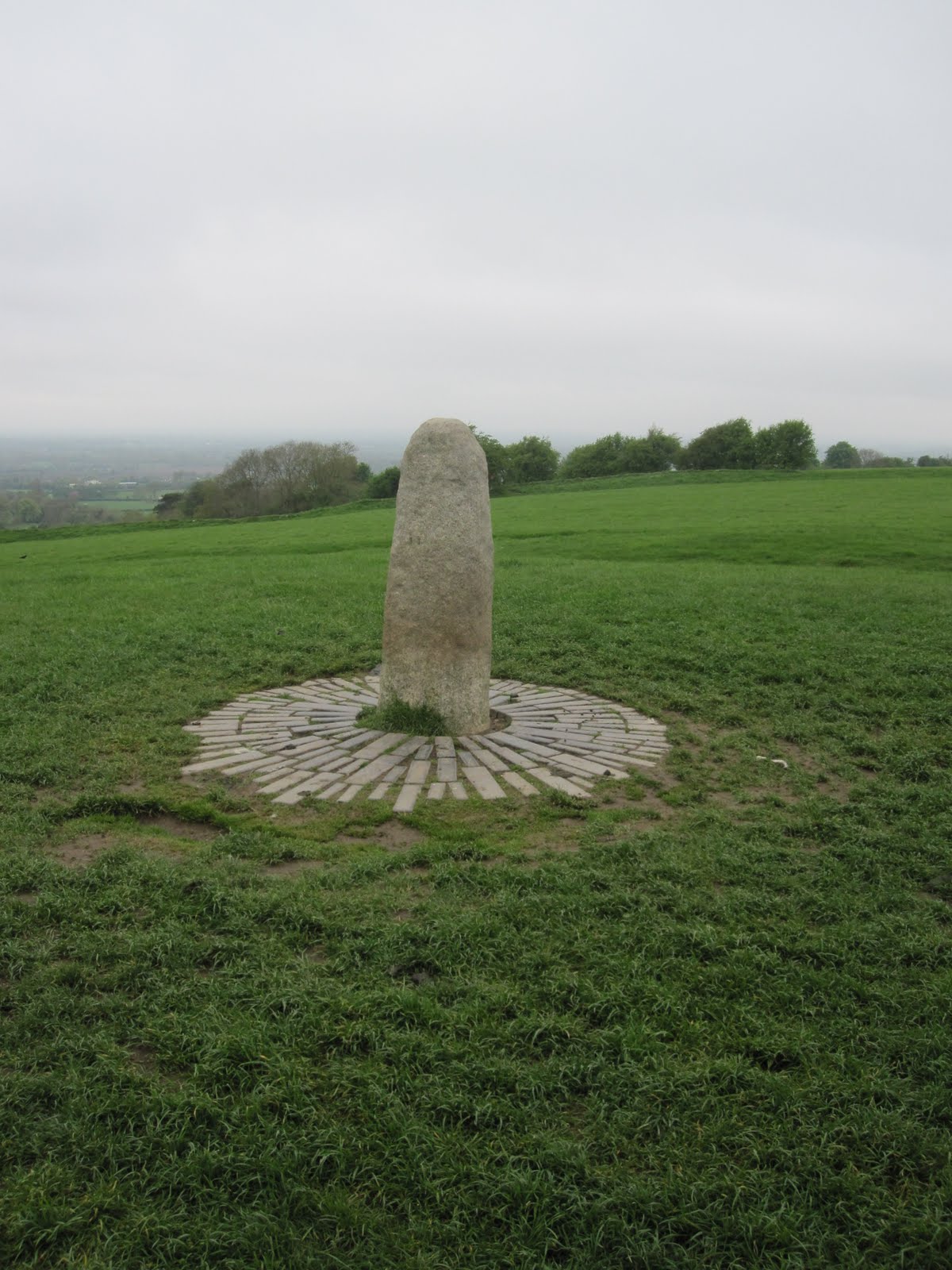
Our first stop was the Hill of Tara. At first glance it doesn't appear to be much more than a grassy hill. However, it happens to be a 5,000 year old meeting place for the high kings of the time.

The stone in the picture above is called the Stone of Destiny. Sounds impressive, doesn't it? According to legend, when the true king touched the Stone of Destiny, the stone would cry out. We all touched it, but none of us will be returning home with crowns. What we can't see from a ground level is that the Hill of Tara was a structured piece of land. Here is a view from above:

The Hill of Tara is an expansive piece of land that once held residences, a cemetery, and what was called the Banqueting Hall. It was a giant hall that was most likely used for an elaborate processional.

This is the Mound of Hostages. Essentially, it was used to hold hostages. What we couldn't see from the outside because there's a gate blocking the entrance were intricate carvings.
The site was used continually through out it's 5,000 year, or so, existence by various groups of people. In the late 1700's, the leader of the United Irish Men held gatherings in this sacred place. The United Irish Men fought in the revolution and consisted of Catholics, Protestants, and those from the North and South, which was quite uncommon. It is fairly poetic that they had meetings at Hill of Tara. There is a monument dedicated to the United Irish Men at the Royal Seat area of the site.

We also had to dodge what Josephine called "Country Raisins." No, they're not delicious sun-dried grapes. Farmers are still allowed to let their sheep or cows graze the fields. Hey, someone's got to do the up keep.


Also on this site was a small church and a statue of St. Patrick.
There was also a Sheela-na-gig (pictured below). Sheela-na-gigs were signs of fertility and sometimes depicted, ahem, rather graphic pictures of women on the statues. What you can't really see is a carving of a woman on the stone. Don't worry, we couldn't see it either. Sheela-na-gigs are common in Ireland. Apparently just by touching a Sheela-na-gig, a woman could become pregnant. Needless to say, all of the ladies on the trip took one giant step back.

Newgrange at Bend in the Boyne:

Our next stop was Newgrange. The site is in the Bend of Boyne, which is known to be the first settlement of the Neolithic (Stone Age) people in Ireland. The passage tombs at this site are a remarkable representation of the intellectual and spiritual minds of these people. The Newgrange structures were build before the Great Pyramid of Giza in Egypt, and these guys didn't even have the wheel invented yet.

The structure in the picture above is one of three passage tombs built in strategic places in the Bend of Boyne area. Each structure is thought to be about 5,000 years old and to have taken two generations of people to build. 4oo men were needed to build these structures and the people who planned the building most likely never saw it finished.

The most amazing part of these tombs is that they were built to line up with the sun. Newgrange, the one above, was built so that on the 21st of December (the shortest day of the year) the rising sun would send a beam shooting through into the passage tomb and illuminating the inside for approximately 17 minutes.

The other two passage tombs, Dowth and Knowth, have the same sort of strategic placement. For Douth the setting sun on the 21st of December sends a beam into the passage. For Knowth, it is the Equinox that provides this sun beam. As the sun rises, it sends a beam into the West side of the structure, and as it sets, it sends a beam into the East side of the structure through another entrance.

Our group had a fantastic time exploring these old structures. Here we are, Moms and Dads and we're having a wonderful time! The area around the Newgrange passage tomb was a prime example of Ireland's country beauty. We all enjoyed it very much.


The Mellifont Abbey:


Our final stop was Mellifont Abbey. This is the first abbey to have been built in Ireland and was initiated by the Cistercian order. In 1142, the Cistercians came to Ireland to build the abbey and help bring a reform that St. Malachy thought was greatly needed in his country.
Sadly, after a great fire in the 1200's, a great residence built on the site, and a great reform led by Henry the VIII, this is all that remains of the Mellifont abbey. The abbey was once one of the richest land owners in the area. The land from Newgrange to Mellifont was owned by the Cistercian order. They rented the land to farmers and the lands were called "granges."

The Cistercians had simple lives, but they were intellectuals and engineers.

This is a model that represents what the abbey would have looked like in its prime.


Sorry for the wordiness of this post, but we saw a lot of amazing things today. There will be more pictures on our Facebook pages.

Tomorrow some of us will be able to visit the national library and trace our heritage back to the Irish. Folks here say, "Scratch a little and you'll find the Irish." Until next time.